
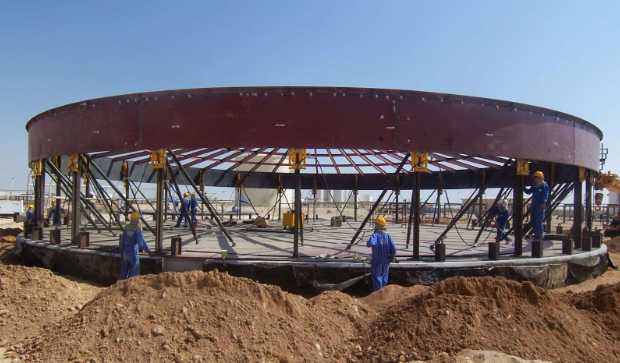


Large storage tanks are widely used in industries such as oil and gas, chemicals, water treatment, and agriculture. Building these tanks is a complex process that requires precision, safety, and efficiency. In recent years, modern construction methods have helped reduce time and labor while improving safety standards. One of the most effective methods is the use of tank jacking equipment. This approach has transformed how large storage tanks are constructed by allowing faster assembly with better control. Understanding how this equipment works and why it is so effective can help project planners and stakeholders appreciate its value.
Understanding the Basics of Tank Jacking Equipment
Tank jacking equipment is a specialized system used to lift and hold heavy steel tank shells during construction. Instead of building the tank from the ground up using scaffolding and cranes for every section, this equipment allows builders to construct the tank from the top down. The roof and top shell are assembled first at ground level, then lifted upward using hydraulic jacks. As the structure rises, new shell plates are added underneath. This process continues until the tank reaches its full height.
By keeping most of the work close to the ground, tank jacking equipment reduces the need for working at extreme heights. This not only improves safety but also makes the construction process faster and more controlled.
Faster Construction Through Top-Down Assembly
One of the biggest advantages of using tank jacking equipment is the speed it brings to construction projects. Traditional tank construction methods often involve assembling shell plates one by one from the bottom up, which requires frequent repositioning of cranes and scaffolding. These steps take time and can slow down progress.
With tank jacking equipment, the top-down approach allows multiple tasks to happen more efficiently. Workers can install and weld shell plates at ground level while the tank is supported by the jacking system. This streamlined workflow reduces delays and allows teams to complete projects in less time without compromising quality.
Improved Safety and Reduced Work at Height
Safety is a major concern in large storage tank construction. Working at high elevations increases the risk of falls and other accidents. Tank jacking equipment significantly reduces this risk by keeping most construction activities close to the ground.
When workers can perform welding, fitting, and inspection tasks at lower levels, it creates a safer working environment. Fewer safety incidents also mean fewer work stoppages, which helps maintain project timelines and supports faster overall completion.
Better Quality Control and Precision
Quality control plays a vital role in the long-term performance of storage tanks. Tank jacking equipment supports better precision during construction by keeping the structure stable and evenly supported during lifting. Hydraulic jacks are designed to lift the tank uniformly, reducing stress on the shell plates and welds.
Because assembly happens at ground level, inspectors can more easily check weld quality and alignment. This improved access allows issues to be identified and corrected early, avoiding rework that could otherwise slow down the project.
Reduced Dependence on Heavy Cranes
Cranes are essential in many construction projects, but they can be expensive and time-consuming to operate, especially for large storage tanks. Tank jacking equipment reduces the need for constant crane use by handling the lifting process internally.
Once the initial setup is complete, the hydraulic jacking system takes over the lifting tasks. This reduces scheduling conflicts, lowers equipment costs, and minimizes downtime caused by crane repositioning. As a result, the overall construction process becomes more efficient and predictable.
Adaptability for Different Tank Sizes and Locations
Another reason tank jacking equipment helps speed up construction is its adaptability. The system can be adjusted to handle tanks of various diameters and heights, making it suitable for a wide range of industrial applications. It is also useful in locations where space is limited or crane access is difficult.
This flexibility allows construction teams to work efficiently even in challenging environments. Fewer logistical issues mean smoother operations and faster project completion.
Conclusion
Tank jacking equipment has become a valuable solution for speeding up large storage tank construction while maintaining high safety and quality standards. By enabling a top-down construction method, reducing work at height, improving precision, and minimizing reliance on heavy cranes, this technology streamlines the entire building process. For industries that depend on timely and reliable storage tank installation, tank jacking equipment offers a practical and efficient approach that supports faster project delivery without sacrificing performance or safety.